A personal essay about inherited risk, generational strength, and choosing to act before fear makes the decision for you.
I come from a line of amazing women.
My mother was so beautiful. And through my eyes, for my entire life, she could do no wrong. She left behind a legacy of kindness, laughter, and compassion. She was adaptable. Resilient. The kind of woman who made things work, no matter what.
And then there was the moment she told me she found a lump.
Breast cancer.
I was 21. She was 42.
She had triple-negative, stage 3 breast cancer. One lymph node was positive – just one. She had delayed her mammogram by six months. Would those six months have made a difference? Would it have been caught before it spread to her lymph node and changed the entire course of her treatment?
Those answers will never be known.
What I do know is this: I am never late for my mammogram. Not by a day.
The news rocked me to my core. I was terrified – not for a moment, but for ten years. Ten years of living with the constant fear of losing her. We talked every day. I knew her struggles intimately. I was there for the surgeries, the recoveries, the side effects. I read doctor reports. I followed the clinical trials she was part of. I joined breast cancer forums and support groups myself.
Cancer was hers – but it was very much my daily reality too.
And when cancer finally took her, I can say this honestly: I never recovered.
I lost my idol. My best friend. The one person in the world who was my safe space. The person who loved me unconditionally, without effort or expectation.
But life doesn’t stop when grief shows up.
You still have to live – just in a new normal. One where a piece of you is missing. Grief is trauma. It’s part of the human condition. And it changes you. It sharpens your awareness of how fragile life is. It makes you grab moments tighter. It makes you proactive. It turns “someday” into “now.”
Then there’s the other amazing woman in my life. My other North Star.
My grandmother.
She was feisty, stubborn, and determined. She aged beautifully – softer, but no less strong. And I know without a doubt that I was loved by her ferociously. I loved her just as fiercely in return.
After my mom passed, she and I lived on an island together – bonded by grief. I depended on her strength as much as she depended on mine.
Aging is a gift, and she was blessed with it. But she lived a hard life. She was a child of the Depression and knew heartbreak early, losing her own mother at a young age. She understood grief as a survival skill. It hardened her, but it also fueled her drive to provide and endure.
Like my mother, she too had breast cancer – diagnosed at 47. I don’t know the type, or if in 1972 they even classified it the way we do now. She had a mastectomy without reconstruction and lived to nearly 98.
Both diagnosed under 50.
Two sides of the same coin.
One a survivor.
One a valiant fighter.
And here is where my story begins.
Because my mother was diagnosed at 42, the protocol was for me to begin annual mammograms ten years prior to her age at diagnosis. So at 32, I had my first mammogram. If I think back hard enough, I may have had one in my 20s as a baseline – and I know this because I remember asking my mom, “What if I pass out?”
(If anyone knows me, you know that’s a valid concern.)
She assured me I wouldn’t. She was right.
But those machines still squeeze you within an inch of your dignity and always leave me feeling like I might pass out anyway.
About ten years ago, I started getting call-backs. Every year: abnormal mammogram. Followed by diagnostic mammograms. Sometimes ultrasounds. Always, thankfully, no cancer.
A few years ago, there was a bigger scare – additional imaging, extra testing, and a lump that required an MRI-guided biopsy. Again, no cancer. But my screening protocol changed. Now it’s mammogram, then MRI. Every six months.
Every six months, you sit in the “what ifs.”
Every six months, the grief gets reopened.
It’s like a wound that never fully heals – it just quiets down before the next appointment.
After my mom passed, I had genetic testing. At the time, it only included BRCA1 and BRCA2. I didn’t carry either. This past November, I completed an expanded genetic panel. Still negative.
But I carry anxiety.
I carry trauma.
And I carry the very real fear of dying from breast cancer.
I carry the fear of my children and husband living the same ten-year nightmare I lived, watching someone they love fight for her life.
I also have extremely dense breast tissue, which is common for many women. Dense tissue shows up white on imaging. You know what else shows up white?
Cancer.
White on white makes detection harder.
My paternal grandmother also had breast cancer – later in life, but still another piece of the puzzle. All of this combined puts my lifetime risk at 47%. Anything over 20% is considered high risk. That’s the line where insurance will approve a prophylactic mastectomy – and we all know insurance doesn’t cover anything it doesn’t deem “necessary.”
This past September, I received yet another abnormal mammogram notification.
That was the moment.
I looked at my husband and said, “That’s it. No more. I’m losing my boobs. They will not kill me.”
I’m an action taker. I research the hell out of things. I lean into information and community because that’s how I cope. I met with three surgeons – one local, and two at Johns Hopkins, because when one of the best hospitals in the world is an hour away, you go.
One of the unexpected benefits of being treated at a world-class medical center is access to clinical research. I was given the opportunity to participate in a clinical trial – not because I’m sick, but because advancement depends on women willing to help shape what comes next.
In a strange way, it felt like honoring the women before me while protecting the ones who come after.
One surgeon described a prophylactic mastectomy as an amputation.
It’s not a limb.
But it is an identifying part of my body.
A part of my womanhood.
And it’s not a decision – or a surgery – to take lightly.
She shared that most of her patients have had a very personal experience with breast cancer and, unfortunately, often a loss that shapes how they view this procedure and their future.
Her patients understand the risks. But they’ve seen, firsthand, the devastation cancer causes. They are educated, aware, and ready for the exhale.
As she said this, I remember thinking, That’s me.
I’m that woman shaped by loss.
I’m that woman ready to exhale.
She laid out my other two options.
I could continue the six-month rotation of imaging and pivot if cancer ever showed up. Or I could take the same medication women with breast cancer take for five years, lowering my risk from 47% to around 20%.
(Still high risk.)
A prophylactic mastectomy would reduce my risk to 2-3%.
My choice.
On March 4th, I’m taking fate into my own hands.
I’m choosing to be proactive.
I’m choosing health.
And I plan to be around for a really long time.
The surgery happens in stages. First comes the mastectomy, followed by a multi-step reconstruction process that takes place over several months. It’s not a quick fix, and it’s not cosmetic in the traditional sense.
It’s strange. It’s emotional. And it’s something I’m still wrapping my head around.
But there’s a plan. And for me, having a plan matters.
Here’s the real part.
I’m still scared.
I’m nervous about a dozen things. I’m not great with medical procedures. I’m not a great patient. I am absolutely going to hate drains, recovery, and being down for a few weeks.
But here’s what I’m going to love.
The knowledge that my breasts no longer have the ability to kill me.
I’m in charge now.
And I get to reshape my identity – leaning into community, sharing my story, and maybe helping someone else feel brave when faced with their own scary truths.
If you haven’t figured it out yet, I’m a sharer. So stay tuned for updates over the next month and post-surgery as I recover.
For now, I’m off to buy drain holders, mastectomy shirts, pillows, chapstick, bendy straws, and everything else recommended by the warriors who have marched this path before me.
And honestly? Probably a cocktail of two!
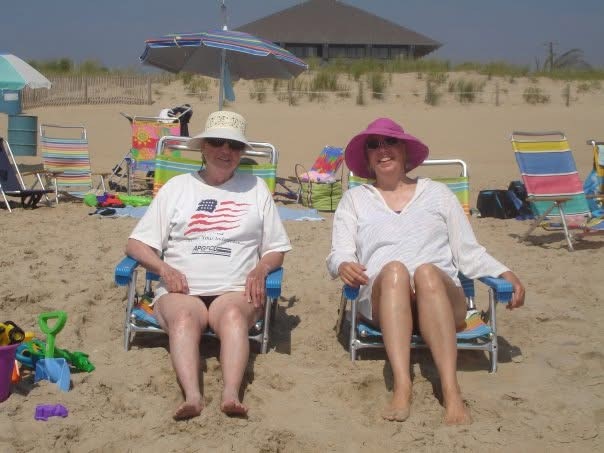
This one is a favorite image of resilience – my Momma was still living life even though she was struggling with a chemo medication.
True to her style, she was all smiles in her happy place with her family.
 LIVE LIFE BIG
Leave a comment